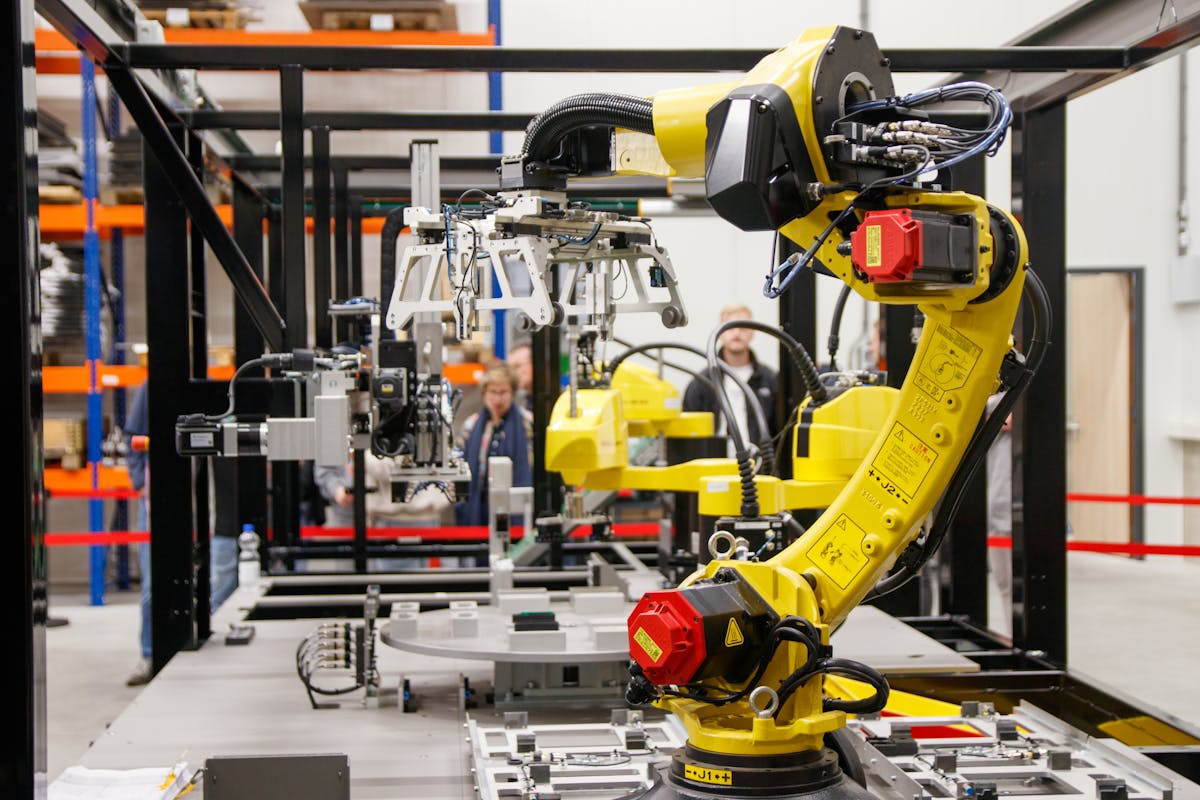
Every AI agent you have read about on this blog lives in software. It calls APIs, processes text, routes tickets, writes code. Physical AI is what happens when that same agentic architecture, planning loops, memory, tool selection, gets wired into a body that can pick up a box, weld a chassis, or navigate a warehouse floor. NVIDIA CEO Jensen Huang declared at GTC 2026: “Physical AI has arrived. Every industrial company will become a robotics company.” The physical AI market is valued at $5.2 billion today and projected to reach $49.7 billion by 2033 at a 32.5% CAGR.
That is not hype layered on hype. Figure AI’s humanoid robots have already assembled over 30,000 BMW X3s at the Spartanburg plant. Amazon runs over one million robots across 300+ fulfillment centers. Waymo logs 450,000 paid rides per week. The transition from prototype to production is already happening.
What Physical AI Actually Means
Huang frames physical AI as the third era of artificial intelligence. Era one was perception AI: systems that could recognize images, understand speech, classify data. Era two was generative AI: models that create text, images, and code. Era three is physical AI: systems that understand the real world and act in it.
The definition from Superb-AI’s research breaks it into three layers. Perception: the robot sees its environment through cameras, LiDAR, force sensors. Cognition: it reasons about what to do next using the same kind of planning loops that power software agents. Actuation: it physically moves, grips objects, navigates spaces.
What makes this different from the industrial robots that have been welding car frames since the 1980s is adaptability. A traditional robot arm follows a hard-coded trajectory. Move to coordinates X, Y, Z. Close gripper. Move to coordinates A, B, C. Open gripper. Repeat ten thousand times. If someone puts the part two centimeters to the left, the robot breaks the part or itself.
From Hard-Coded to Agentic
A physical AI agent perceives the shifted part, re-plans the grasp, adjusts force based on sensor feedback, and completes the task. It generalizes to new situations the way a software agent generalizes to new queries. General Robotics documented that their agentic system achieved “zero-shot generalization” across manipulators, legged robots, humanoids, and aerial platforms, recombining existing skills in new contexts without retraining.
This is the same architectural pattern behind every software agent: a planning module breaks complex tasks into steps, a skill library provides capabilities, and a memory system tracks what has been tried and what worked. The only difference is that the “tools” are physical actuators instead of API endpoints.
The Technology Stack Behind Physical AI
NVIDIA’s GTC 2026 announcements revealed the most complete physical AI stack anyone has shipped so far. It mirrors software agent architecture almost exactly, but with hardware in the loop.
World Models: The Robot’s Internal Simulator
Cosmos 3 is NVIDIA’s world foundation model. It unifies synthetic world generation, vision reasoning, and action simulation into a single system. Think of it as the robot’s imagination: before reaching for a part, the agent simulates the grasp in Cosmos, evaluates whether it will succeed, and adjusts if the simulation predicts a failure. Software agents do something similar when they plan multi-step tool calls before executing them.
Newton Physics Engine 1.0 provides the physics simulation layer. Samsung demonstrated robots learning cable handling through Newton’s physics predictions rather than thousands of real-world trials.
Action Models: From Plan to Motion
GR00T N1.6 and N1.7 are vision-language-action models specifically for humanoid robots. They take visual input and language instructions, then output full-body motor commands. The newer GR00T N2, previewed at GTC, succeeds at new tasks more than twice as often as competing models and ranks first on the MolmoSpaces and RoboArena benchmarks.
Alpamayo applies the same architecture to autonomous vehicles: camera input goes in, steering and acceleration commands come out, trained end-to-end. NVIDIA calls it “the world’s first thinking, reasoning autonomous vehicle AI.”
The Software Agent Parallel
The architectural parallels are striking. In a software agent, you have:
- Planning: An LLM decomposes a goal into subtasks
- Tool use: The agent selects and calls APIs
- Memory: The agent remembers context across steps
In a physical AI agent, per the General Robotics agentic framework:
- Planning: An LLM decomposes “fetch the component from shelf B3” into perceive, navigate, grasp, return
- Skill libraries: Modular capabilities exposed via the Model Context Protocol (MCP), with standardized APIs that an LLM can discover and compose
- Two types of memory: Observational memory (semantic snapshots of the environment, object locations, spatial layout) and operational memory (which skills worked, execution details, regulatory constraints like FAA drone regulations)
The output is not an API call. It is an auditable Python program that orchestrates physical actions, step by step, with human feedback integration built in.
Who Is Deploying Physical AI Right Now
This is not a research story. Production deployments are running at scale across multiple industries.
Humanoid Robots in Manufacturing
Figure AI raised $1 billion in Series C funding at a $39 billion valuation, a 15x increase in 18 months. Their Figure 02 robots worked at BMW’s Spartanburg plant for over 1,250 operating hours, moving 90,000+ components. The Figure 03, introduced in late 2025, uses the “Helix” AI model for high-volume manufacturing tasks.
Tesla Optimus Gen 3 integrates xAI’s Grok LLM for language understanding with Full Self-Driving neural networks for movement. Production began at Fremont in February 2026, though Musk confirmed the initial batch is for learning and data collection, not productive work yet. Target price: $20,000-$30,000 per unit.
Boston Dynamics Atlas went fully electric, with 56 degrees of freedom and 50 kg lift capacity. The production version launched at CES 2026 with Hyundai and Google DeepMind deployments committed.
Warehouse and Logistics
Amazon’s robot fleet crossed one million units in mid-2025. Their DeepFleet generative AI model coordinates fleet movement and improved travel time by 10%. Next-generation fulfillment centers will have ten times as many robots as current facilities.
Autonomous Vehicles
Waymo served 14 million trips in 2025, tripling the previous year. Their fleet has logged 200 million fully autonomous miles with 91% fewer serious-injury crashes than human drivers. A $16 billion funding round in February 2026 at a $126 billion valuation is funding expansion to 20+ additional cities including Tokyo and London.
The German Advantage: Physical AI Meets Industrie 4.0
Germany’s manufacturing DNA makes it one of the most natural markets for physical AI. Several DACH companies are already leading deployments.
BMW: Humanoid Robots in Leipzig
BMW is deploying AEON robots (built by Hexagon Robotics in Zurich) at Plant Leipzig, marking the first humanoid robot deployment in European automotive production. Test runs started in December 2025; the pilot phase runs through summer 2026. Tasks include assembly of high-voltage batteries and exterior part manufacturing. BMW also established a “Center of Competence for Physical AI in Production.”
Siemens + NVIDIA: The Industrial AI Operating System
Siemens and NVIDIA announced a partnership at CES 2026 to build an “Industrial AI Operating System.” The first blueprint is being deployed at Siemens’ electronics factory in Erlangen, Germany. CEO Roland Busch called it “redefining how the physical world is designed, built, and run.” The target: 2-10x speed-ups in semiconductor design workflows. Foxconn, HD Hyundai, and KION Group are evaluation partners.
NEURA Robotics: Stuttgart’s Humanoid Startup
NEURA Robotics, based near Stuttgart, raised EUR 120 million in Series B funding in January 2026. They partnered with Qualcomm for processing and Bosch for production expertise. Their biggest move: launching the TUM RoboGym with the Technical University of Munich, Europe’s largest physical AI training center, backed by EUR 17 million in investment.
Agile Robots: Munich’s Revenue Machine
Agile Robots, headquartered in Munich, acquired thyssenkrupp Automation Engineering in November 2025 and doubled revenue to EUR 200 million. Their Agile One humanoid robot enters production at their own Bavarian plant in early 2026. They are also the anchor customer of Deutsche Telekom and NVIDIA’s Industrial AI Cloud, Europe’s first.
Regulation: The EU AI Act and Physical AI
The EU AI Act’s high-risk classification will directly affect physical AI deployments. The timeline matters:
- August 2, 2026: All high-risk AI systems must comply with risk management, data governance, and conformity assessment requirements
- August 2, 2027: High-risk AI embedded in regulated products (machinery, medical devices) must comply
- January 20, 2027: The new EU Machinery Regulation (2023/1230) takes effect, replacing the old Machinery Directive
The Machinery Regulation now explicitly covers AI safety components that use machine learning and exhibit self-evolving behavior. If your robot qualifies as machinery AND uses a high-risk AI system as a safety component, it falls under both the Machinery Regulation and the AI Act. That means mandatory third-party certification.
Collaborative robots (cobots) get special attention. The regulation requires new safety solutions for human-robot shared spaces, including assessment of psychological stress on workers who share a workspace with autonomous machines.
For enterprises planning physical AI deployments, the compliance clock is already ticking. The August 2026 deadline is five months away.
Frequently Asked Questions
What is physical AI?
Physical AI refers to AI systems that can perceive, reason, plan, and act in the physical world. Unlike generative AI (which creates text and images) or perception AI (which classifies data), physical AI gives robots and autonomous machines the same agentic capabilities as software agents: planning, memory, and tool use, but applied to real-world movement and manipulation.
How is physical AI different from traditional industrial robots?
Traditional industrial robots follow hard-coded trajectories and cannot adapt to unexpected changes. Physical AI agents use agentic architectures with planning loops, sensor feedback, and memory to adapt in real time. If a part shifts position, a physical AI robot re-plans its grasp automatically. This zero-shot generalization across new situations is what distinguishes physical AI from conventional automation.
Which companies are leading physical AI in 2026?
NVIDIA provides the foundational technology stack (Cosmos, GR00T, Isaac Lab). Figure AI deployed humanoid robots at BMW’s Spartanburg plant. Amazon runs over one million warehouse robots. Waymo operates 450,000 paid autonomous rides per week. In Germany, BMW, Siemens, NEURA Robotics, and Agile Robots are leading production deployments.
How does the EU AI Act affect physical AI and robotics?
The EU AI Act classifies AI safety components in machinery as high-risk, requiring risk management, data governance, and conformity assessment. The August 2026 deadline covers all high-risk AI systems, and the new EU Machinery Regulation (effective January 2027) explicitly addresses self-evolving AI in robots. Collaborative robots require mandatory third-party certification.
How big is the physical AI market?
The physical AI market was valued at $5.2 billion in 2025 and is projected to reach $49.7 billion by 2033, growing at 32.5% CAGR. The broader AI-in-robotics market is expected to hit $182.7 billion by 2033. Humanoid robots alone represent a $38 billion opportunity by 2035 according to Goldman Sachs.